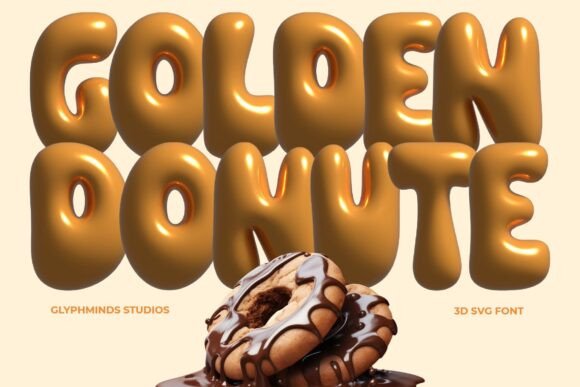
Golden Donut: A Fresh Take on Fun Typography
When you are scrolling through a feed or walking down an aisle, your eyes naturally gravitate toward things that look appetizing. We are biologically wired to appreciate shine, volume, and color. This is exactly why the Golden Donut font works so effectively in modern design. It isn’t just a set of letters; it is a visual treat that mimics the glossy, irresistible sheen of a freshly glazed pastry. If you have been looking for a way to inject personality into your projects without resorting to childish clipart, this 3D SVG typography offers a sophisticated yet playful solution.
Understanding the Visual Appeal
At its core, Golden Donut is a display font. This means it is designed specifically for impact rather than long-form reading. You wouldn't use it to write a blog post, but you would absolutely use it to headline one. The defining characteristic here is the 3D SVG technology. Unlike standard flat vector fonts, this typeface includes built-in depth, texture, and lighting. It looks like it is literally popping off the screen. The "glaze" effect catches light, creating a premium font experience that usually requires hours of manual work in Adobe Illustrator or Photoshop to achieve.
The personality of this typeface is unapologetically bold. It bridges the gap between a handwritten font and a structured sans serif font. It has the roundness and softness of a script font but the legibility of a blocky headline. For designers, this is a massive advantage. It allows you to create that "Instagram-ready" aesthetic instantly. The visual weight of the letters ensures that your message stands out, whether it is placed over a busy photograph or a minimalist solid color background.
Practical Applications: Where to Use Golden Donut
The versatility of a creative font like this is surprisingly broad. Because it carries such a distinct vibe, it works best in scenarios where you need to establish an immediate emotional connection. Here are a few practical ways to integrate it into your workflow:
- Branding and Logo Design: If you are launching a bakery, a coffee shop, a toy brand, or a lifestyle blog for a younger demographic, Golden Donut can serve as the foundation of your logo design. It communicates friendliness and approachability. However, remember that SVG fonts can be tricky to scale infinitely in vector software; they are best used for web-based logos or print media where high resolution is maintained.
- Packaging Design: On physical products, shelf appeal is everything. This font shines on packaging for snacks, cosmetics, or party supplies. The glossy texture mimics real-world materials, making the product look more tangible and appetizing before the customer even touches it.
- Digital Marketing and Social Media: For social media graphics, attention spans are short. You need to stop the scroll. The 3D depth of this font grabs attention faster than standard flat text. It is perfect for YouTube thumbnails, Instagram story sale announcements, or header images for Facebook groups.
- Editorial and Web Design: While you wouldn't use it for body text, it is excellent for editorial design headers. If you are designing a magazine cover or a landing page hero section, using Golden Donut for the main headline can set a playful tone immediately.
Strategic Design: Hierarchy and Pairing
Using a heavy, textured font requires a bit of strategy. If you use it for everything, your design will look cluttered and chaotic. The key is visual hierarchy. Use Golden Donut for your primary headline—the one thing you want the viewer to read first. Then, pair it with something much simpler for your sub-headlines and body copy.
A classic rule of thumb in modern typography is to pair opposites. Since Golden Donut is round, glossy, and loud, you should pair it with a clean, geometric sans serif font. Think of fonts like Montserrat, Roboto, or Open Sans. These neutral typefaces provide a "quiet" background that allows the Golden Donut to be the star of the show without overwhelming the viewer. Avoid pairing it with other decorative serif fonts or complex script fonts, as this will result in a visual clash that confuses the reader.
Technical Considerations and Licensing
Before you download and install, it is important to understand how SVG fonts work. Because they contain bitmap data to create the texture and lighting effects, they have larger file sizes than standard OTF or TTF fonts. They also behave differently in design software. In some older versions of design tools, you might not see the color or texture until you export the file. Always test the font in your specific software environment (like Photoshop CC or Illustrator) to ensure it renders correctly.
Furthermore, check the licensing. Since this is a commercial font, you need to ensure your license covers your specific usage. If you are a small business owner using it for your own branding, a standard license usually suffices. However, if you are a designer creating templates to sell on marketplaces, or a publisher distributing the font within a digital product, you will likely need an extended license. Always read the terms to avoid legal headaches down the road.
Ultimately, Golden Donut is more than just a novelty; it is a strategic design asset. It solves the problem of needing high-quality, 3D text effects without requiring advanced technical skills. By understanding its strengths and pairing it wisely, you can elevate your projects from generic to memorable. It adds that final layer of polish that tells your audience you care about the details, sweetening the deal for anyone who encounters your work.